
Plenty of people spend months staring at a bump that never quite dries up, a spot that wasn't there last year or an itch that shows up every night, with no idea who to ask. They type "skin clinic near me" into their phone, see appointments weeks away and put it off. Meanwhile they dab on toothpaste, lime juice, diluted bleach or whatever ointment a neighbor passed along.
Skin is the organ everyone can see, and oddly enough one of the last people get looked at. This guide sorts the usual worries of adults in Aldine and north Houston into three simple groups (things that pop up, things that change color and things that itch) and explains which part a general visit can handle and when, as general medical guidance, a specialized evaluation is the better route.
Start with a useful question: since when, and what changed?
Before worrying about a name for the problem, pay attention to three things, because they are exactly what you will be asked at the visit:
- Timing. Did it appear overnight or has it been there for months? Sudden problems usually have a trigger (a food, a new soap, a bug bite); slow ones call for a closer look.
- Change. Is it growing, changing color, bleeding, opening up or staying the same?
- Company. Does it come with fever, strong pain, swelling or feeling unwell, or is it only the skin?
A dated photo every three or four days beats any description from memory. Take it in good light with a coin next to the spot so the size is clear.
Things that pop up: pimples, lumps and bumps
Not everything raised on the skin is "a pimple." In practice there are a few different things worth telling apart:
- Adult acne. Breakouts on the face, chest or back are not just a teenage problem. Sweat, a work helmet or cap, stress and some hair or face products make them worse. Squeezing them leaves dark marks and scars that last far longer than the pimple did.
- The boil that hurts. When the lump is red, warm, throbbing and more painful each day, it is no longer an ordinary pimple: it may be an abscess, a pocket of pus under the skin. The clinic offers abscess drainage under local anesthesia; don't pop it at home with a needle, since the infection can be pushed deeper.
- Painless lumps. A cyst on the back or neck, or a lipoma (a soft fatty lump that slides under your fingers on the shoulder or arm), usually grows very slowly. If it bothers you or rubs against your clothes, the clinic's medical team can assess whether it can be removed through minor surgery in the exam room.
As a general rule, acne that leaves pitted scars, forms deep painful lumps or doesn't improve after several months of steady care is one of the situations where a specialized evaluation usually makes sense. Bring it up at your visit along with a list of everything you have already tried.
Things that change color: spots and moles
Spots are the complaint people put off the longest, because they almost never hurt. Some are harmless: the darkening a pimple left behind, sun spots on the forehead and arms of people who work construction or outdoors, or darker, velvety skin on the neck and armpits, which is sometimes linked to high blood sugar and deserves a general checkup.
Moles need more attention. The American Cancer Society sums up the warning signs with five letters, the ABCDE rule:
| Letter | What to look for in the mole |
|---|---|
| A, asymmetry | One half doesn't match the other |
| B, border | Ragged, blurry or notched edges |
| C, color | Several shades: brown, black, reddish, gray or bluish |
| D, diameter | Larger than a pencil eraser |
| E, evolving | Changes in size, shape or color, itches or bleeds |
If a mole fits any of those letters, especially E, have it looked at soon. When a lesion's appearance calls for it, general medical guidance is to get a specialized evaluation rather than simply removing it; when a mole is just in the way and looks calm, the clinic's medical team can assess whether it is a candidate for removal in the office.
Things that itch: hives, rashes and fungus
Itching has many causes, and the most confusing kind comes and goes. Three common situations:
- Hives or red skin after something new. A detergent, a perfume, shellfish or a medicine you recently started. This is checked at the allergy visit, where the medical team asks when it began, looks at the affected skin and works out what is setting it off.
- Fungus. Athlete's foot between the toes, an itchy groin in summer or round patches that spread with a redder edge are common in Houston's humid heat, especially with work boots or clothes that stay damp. Keeping the area dry and not sharing towels or flip-flops helps keep it from coming back.
- Dry skin. On cold days and after very hot showers, the skin on legs and arms dries out, cracks and itches. Short lukewarm showers and an unscented cream after patting dry are usually enough.
Hard scratching opens tiny wounds where bacteria can get in. Keep your nails short and, if the itch keeps you awake, don't wait for the skin to get damaged before you come in.
When the problem has turned into a wound
Sometimes what started as a scratched pimple, a blister or a scrape becomes a wound that starts to look bad. The clinic's wound care means cleaning it, changing the dressing and checking its color, size and drainage at each visit. If you live with diabetes, check your feet every day: a small wound there can get complicated and is not worth waiting on.
What happens at a skin visit at the clinic
- You are asked how long you've had the problem, what you've put on it and whether anything is new at home, at work or in your diet.
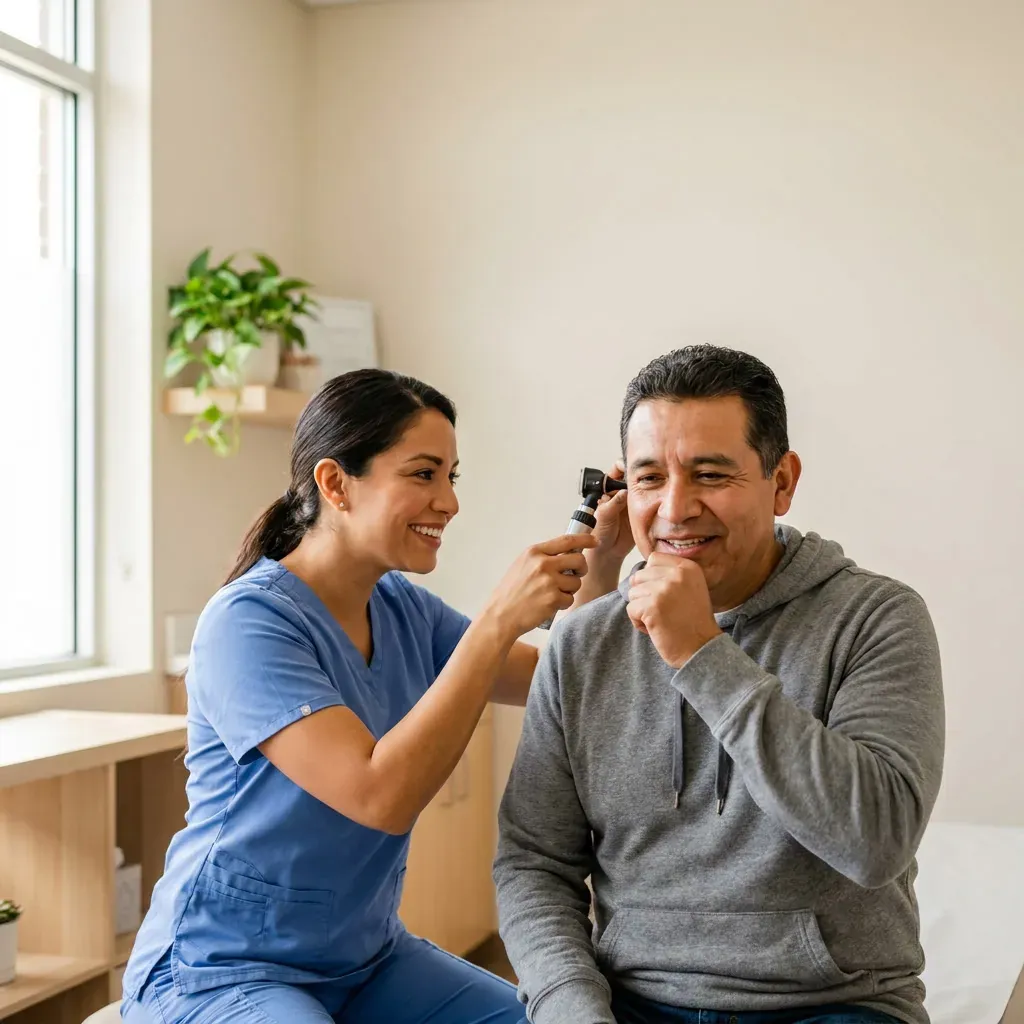
- The clinic's medical team examines the area in good light and, if needed, other parts of your body.
- Together you decide whether it can be handled at the visit (draining an abscess, caring for a wound, starting allergy treatment) or whether, as general guidance, a specialized evaluation is a better fit.
- If something is prescribed, you buy right there what the medical team prescribed at the pharmacy inside the building, and before you leave they explain in Spanish how to apply or take it and what to do if your skin gets irritated.
Not for a clinic visit: go to the ER or call 911
- Red skin that spreads quickly, with fever or chills.
- After a sting, a meal or a new pill, your lips, tongue or eyelids puff up or you feel you can't get air in.
- A wound that keeps bleeding even with firm pressure.
- Red streaks running up from a wound or a lump.
- Confusion, heavy drowsiness or someone who looks very ill.
What's worth bringing to the visit
To get the most out of the skin exam, gather these before you leave home:
- The dated photos you've been taking.
- The bottles, creams or soaps you used on the area, or a picture of their labels.
- A list of your medicines, vitamins and herbal teas.
- If you can, skip makeup or lotion on the spot that day.
If you live or work along Airline Drive in 77037 and have had a pimple, a spot or an itch that won't clear up for weeks, there's no need to keep guessing in the mirror: bring your photos and the bag of products you've tried, and the clinic's medical team will tell you plainly what can be treated there and what is worth checking further.
Need medical attention?
We're here to help. Call now to schedule your appointment or visit our clinic without an appointment.
Call now: +1 (281) 741-2157